
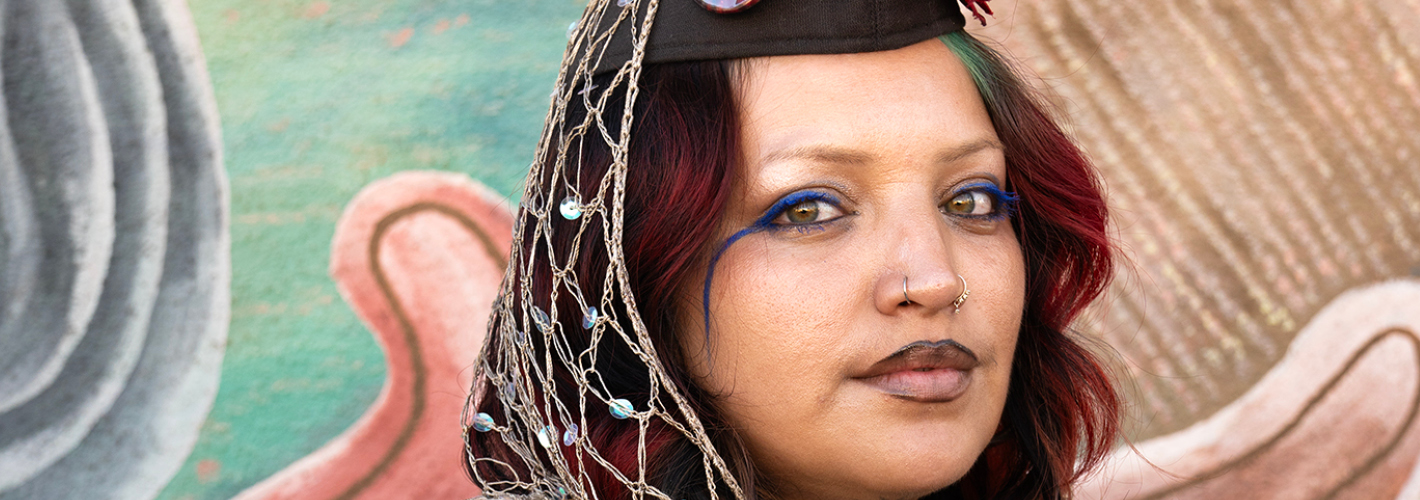
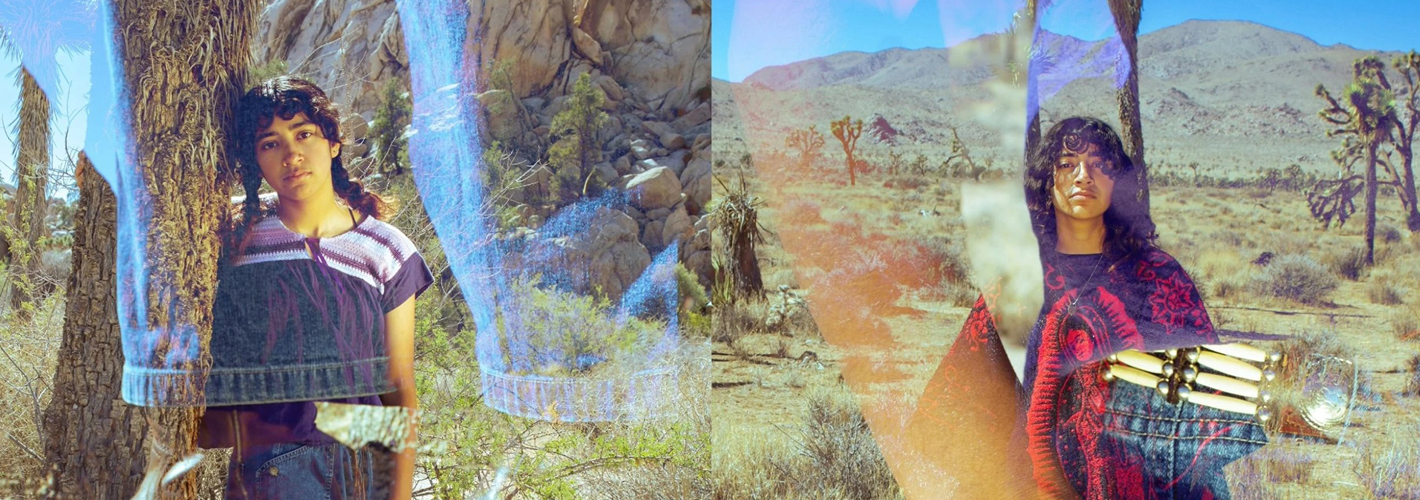

In Blessings from the Three, Amina Cruz transforms the redlined landscapes of Los Angeles into living sites where histories and hauntings of dispossession, queer memory, and communal feeling persist in the present through enduring relationships to place. To be invited into Cruz’s Los Angeles is to be inundated by a transgenerational queer affect felt by Brown queers from carrying this violence for their communities. Over time, this heredity begins to form a kind of forcefield—or even an armor—akin to what Gloria Anzaldúa names la facultad: “an acute awareness mediated by the part of the psyche that does not speak, that communicates in images and symbols which are the faces of feelings, that is, behind which feelings reside/hide.” And, most importantly, from la facultad we encounter those whose “sensitivity is excruciatingly alive to the world,” as Anzaldúa, our ancestral tortillera herself, tells us from the afterlife. Cruz recenters these “faces of feelings” in the queer bodies and landscapes that have carried the violence of these geographies: Tortilleras, Jotos, and Potaxies.
This queer Brown heredity that Anzaldúa bequeaths to us invents new languages and modes of living: Tortilleras and Jotos as subjectivities reclaimed from the ontological experience of “feeling” like a cockroach, as Xandra Ibarra has shown us; and Potaxies as a playful nod to contemporary queer Latine meme culture and digital kinship.
Read more
Leaning on the materiality of the sun-printing process of cyanotype, Cruz adds layers of aesthetic labor by processing these specific, marginalized landscapes on mirrors, implicating spectators within the images themselves. Reflection becomes participation, expanding the borders of the landscape beyond the frame. These mirrored landscapes become the terrain upon which Cruz imagines a sacred trinity of la Tortillera, el Joto, y les Potaxie who carry these inherited states of dispossession in their queer bones. If the mirrored landscapes hold histories of dispossession, the dance floor becomes the space where those histories are sublimated for the anger, sadness, love, and joy of the sublime. It’s a space and time to dress chunti, to be excessive, or to raise your voice in song as acts of both refusal and surrender. The redlined dance floors become a sacred terrain where cultural memory is not abandoned, but rewritten.
Judith Rodríguez, PhD
Curated by Aaron Gomez.
Presented in collaboration with

Made possible, in part, by the generous support of Diane Allen.
These exhibitions are presented by The Luckman as part of FotoSoCal by CuratorLove; a constellation of exhibitions featuring the work of emerging Latine/x photographers and lens-based art. FotoSocal brings together over 20 community college galleries and affiliated spaces across Southern California, including Los Angeles, San Bernardino, Riverside, San Diego, and Orange County.
Amina Cruz | Artist
Amina Cruz is an artist born and raised in Los Angeles, CA. She spent her teenage years in Tampa, FL, and then hitchhiked around the country before deciding to move to New York City, where she earned her BFA in Photography from Parsons School of Design. She also holds an MFA from the University of California, Los Angeles.
Cruz’s photographs are utopias and landscapes filled with conversations, power, relationships, memories, joy, and fantasies that you can feel. Her interests are based in queer culture, film/analog photography, and the space between transformation and identity. Her work has been exhibited at MOCA Tucson, San Diego Art Institute, Creative Center for Photography, The Getty, and galleries throughout the country. Cruz’s work is held in various private collections and institutions, including Loyola Marymount University, the University of California, Santa Barbara, and The Getty.
Aaron Gomez | Curator
Aaron Gomez is a Los Angeles-based curator. He carries a BFA from the University of New Mexico. Since 2021, he has been Gallery Manager at The Luckman Fine Arts Complex at Cal State LA. He previously served as curator at Haphazard Gallery. Recent curatorial highlights at The Luckman include solo presentations of artists Brian Zamora and Raymundo T. Reynoso.
Steve Galindo | Curatorial Contributor
Steve Galindo, aka THESTYLEGUYDE, is an emerging, multi-media Los Angeles-based artist and curator. Galindo has a background in entertainment, fashion, and art; they have spent the last decade in entertainment and fine art learning from prominent artists, community, and foremost thought leaders, formulating an artistic philosophy steeped in a desire to express unifying truths about the human experience.
THESTYLEGUYDE stands for “Uniting Communities through the Language of Art in hopes of driving conversation of change for marginal communities, including and not limited to BIPOC and LGBTQA+ in the United States. “My goal in my community-building work is to build out a paradoxical bridge of conversations that intersect our communities and respective lives.” Their exhibitions have been featured in The Los Angeles Times, Aspen Times, Los Angeles Magazine, and in local and national television news stories.
Judy Rodriguez | Curatorial Contributor
Judith Rodríguez is a first-generation scholar and assistant professor in the Department of Gender Studies and the Latino Studies Program at Indiana University, Bloomington. She specializes in transdisciplinary approaches to Black and Afro-Latiné feminism and literary and performance theory. Her first manuscript, titled Impositions: The Aesthetic Blackening of Puerto Ricanness, explores works of literature, music, documentary film, and theatre and performance since the 1930s that have critiqued—and imagined alternatives to—the gendered antiblack violence produced through the imposition of ethnonational discourse on the colony of Puerto Rico and its diaspora. She has published or has forthcoming articles in Critical Times, Chiricú, small axe, Liminalities: A Journal of Performance Studies, and Hispanófila: Ensayos de Literatura.
- Past Events:
Opening Reception
Opening Reception
Saturday, August 1, 2026
6:00 PM – 9:00 PM
Featuring performances by Los Angeles-based DJ collective Butchona.

Artist Talk and Walkthrough
Saturday, September 5
1:00 PM
Artist Talk with Amina Cruz
Exhibition walkthrough
Portrait Workshop
Hosted by Botitas
12:00 PM – 2:00 PM
Free Portrait Workshop
Bring your camera (phone works too!) and join Amina for a beginner-friendly photography workshop! Learn the basics, connect with other photography lovers, and practice taking portraits of each other in a fun, low-pressure setting. Bring a friend to photograph 🌹
1:00 PM – 4:00 PM
DJ Sets by Fina, Huevito, & Amulette
Enjoy live DJ sets throughout the afternoon while you explore, connect, and hang out. Quiet hours 12-1 & 4-5.
Come for the workshop, stay for the music, and experience the exhibit together w comunidad.
Botitas is a community of trans & queer folx and our loved ones, coming together to create a world where we are celebrated, embraced, and protected. We are storytellers and creators, bridging generations through collective learning spaces, mutual care, and the reimagining of cultural traditions.
Closing Day Celebration
Free Portrait Workshop hosted by Botitas
Bring your camera (phone works too!) and join Amina for a beginner-friendly photography workshop! Learn the basics, connect with other photography lovers, and practice taking portraits of each other in a fun, low-pressure setting. Bring a friend to photograph
Curator Walkthroughs of Blessing from the Three and FuturoGenerational
DJ Sets by Fina, Huevito, & Amulette
Enjoy live DJ sets throughout the afternoon while you explore, connect, and hang out. Come for the workshop, stay for the music, and experience the exhibit together w comunidad.
Exhibition Hours
August 1 – September 12, 2026:
Wednesday – Saturday
12:00 p.m. – 5:00 p.m.
During Luckman Theatre presentations:
1 hour prior to start time + during intermission.
By appointment:
To request, please email us here.
Admission to The Luckman Gallery is free.
Parking
Guest parking permits can be purchased at physical pay stations located in designated pay lots or through PayByPhone. All permits are virtual, and your vehicle’s license plate number is required at the time of purchase.
PayByPhone
– Current rate for a one-hour parking permit: $4.30
– Visa and MasterCard only.
– The rate is inclusive of all taxes and fees.
One-Hour Parking
One-hour parking permit is available at:
- Lot 4A — PayByPhone location code: 1576
- University Student Union lot — PayByPhone location code: 1577
Please note: Only one-hour daily permits are available and valid in these locations.
Additional Parking
Parking is also available directly in front of The Luckman on the top level of Structure C. During campus events and performances, as well as on weekends, event parking rates apply in this structure.
Directions to The Luckman Gallery
From Lot 4A — Google Maps
From University Student Union — Google Maps
From Structure C — Google Maps
From the Cal State LA Transit Center — Google Maps
- Save the Date:
Opening Reception
Saturday, August 1, 2026
6:00 PM – 9:00 PM
Featuring performances by Los Angeles-based DJ collective Butchona.
Reservations are not required, but we ask that you kindly RSVP here.