
The Luckman Gallery is pleased to present After Life, a group exhibition curated by Kristine Thompson. The show features historical and contemporary artwork that examines death, mourning traditions, and memorials, and how our understanding of these ideas and practices has changed over time. The work on view demonstrates a shift from overt representations of death via the body to contemporary artists grappling with death in more fragmented ways, often where the body or loss is represented as a trace, via abstraction, or where emphasis is placed instead on memorial objects or sites of significance. The show includes work by Andrea Bowers, Ellen Carey, Alexandra Pacheco Garcia, Jason Lazarus, David Maisel, David Orr, Ira Sachs, Loren Schwerd, Sarah Sudhoff, and objects from the collection of UCR/California Museum of Photography.
The 19th and 20th-century photographs from the collection of UCR/CMP serve as an introduction and epilogue to the exhibition and keep the historical precedents in direct visual conversation with contemporary works. These photographs range from post-mortem daguerreotype portraits to instant prints from the 1970s and 80s of mourners posing alongside the deceased.
Ellen Carey
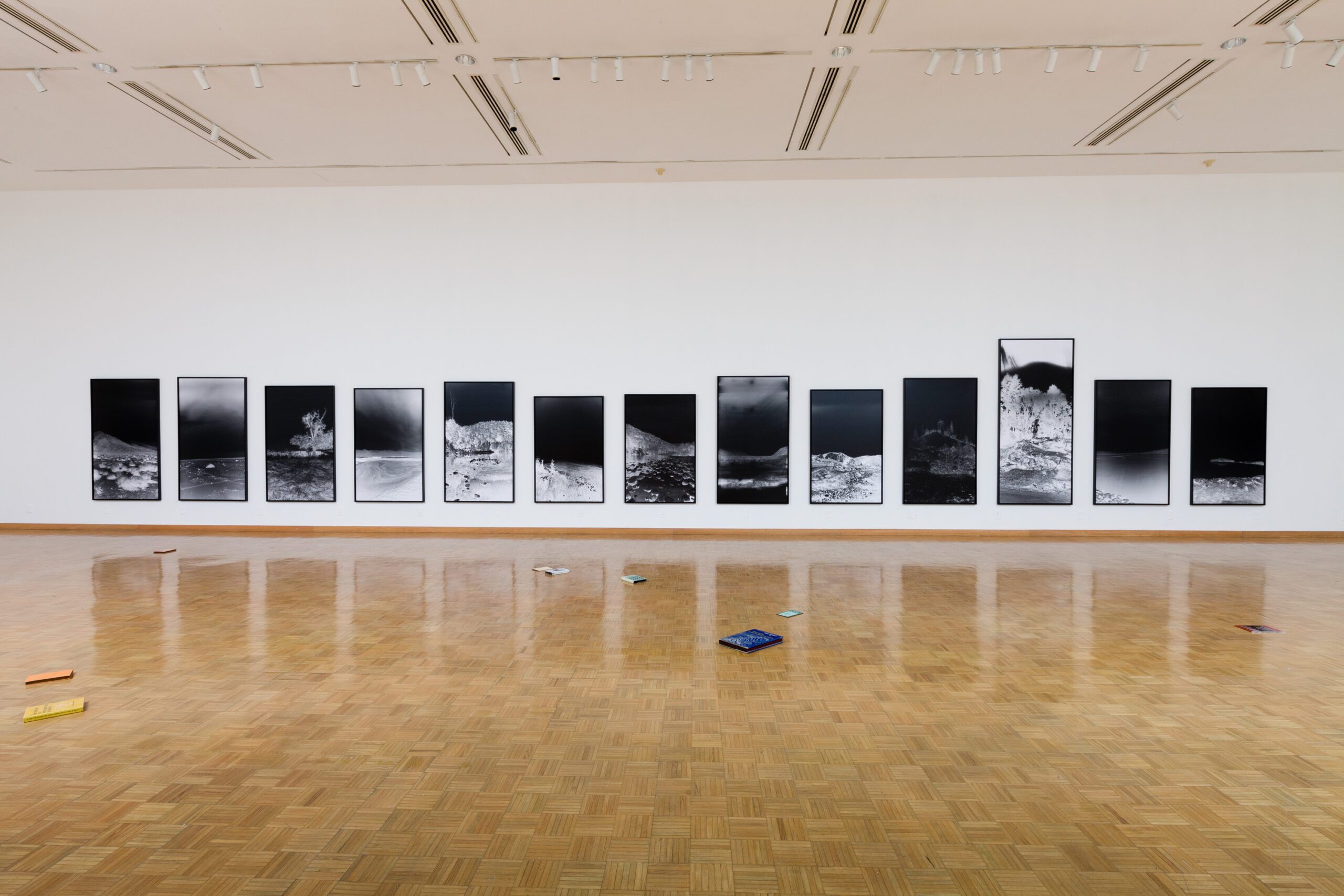
The installation of contemporary work is anchored by Ellen Carey’s monumental Mourning Wall, composed of 100 grey Polaroid negatives, made with a large-format Polaroid 20 X 24 camera. Created at the turn of the millennium, the group of negatives suggests a way of representing both collective and individual loss.
About the Panelists
Keko Jackson
Keko Jackson is an artist and archivist living in Los Angeles. His work extends across photography, curation, writing and publications that take a discursive approach to history and its relationship to images.
Leah King
Leah King is a multimedia artist working in collage, sound, film, and performance. Her intricately layered visual and sonic works explore race, gender, and power through a futurist lens. Centering archives as portals for future-building, King creates multisensory installations rooted in ancestral storytelling and community repair. As a vocalist and composer, she creates soundscapes influenced by house, gospel, and experimental jazz. King’s work has been exhibited at SFMOMA, the Contemporary Jewish Museum, and Charlie James Gallery, and supported by the Brooklyn Arts Council, Berlin Music Board, and many others. She holds an MFA from USC Roski School of Art and Design, where she researched house music and Black futurity, and a BA from Barnard College/Columbia University in Black diasporic music and dance.
Lylliam Posadas
Lylliam Posadas is the Co-Founder and Co-Director of Your Neighborhood Museum and the Colonial Pathways Repatriation Manager at the Museum of Us. Lylliam has over 15 years of experience in repatriation and focuses on collaborative program development, community-led research practices, and transformative justice practices in museums. Lylliam has field experience in Ghana, Peru, Louisiana, and California, as well as experience facilitating repatriation, building repatriation programs, and guiding research protocols at the Fowler Museum at UCLA, the Autry Museum of the American West, and the Museum of Us. Lylliam received an M.Sc. in Technology and Analysis of Archaeological Materials from University College London and Bachelor degrees in Anthropology and Psychology from UCLA.
Moriah Ulinskas
Moriah Ulinskas is a community archivist and public historian whose research examines histories of dispossession, focusing on how marginalized communities organized to resist displacement and how that history of resistance lies latent in archival collections today. Her work investigates both the physical displacement of minority communities and their erasure from historical memory, examining how these groups preserved their stories despite systematic exclusion from official narratives. She is a founding member of the Community Archiving Workshop (CAW), a collective of audiovisual archivists who facilitate audiovisual preservation in community-held collections. Since 2011, CAW has collaborated with 65 organizations across four continents to conduct archival preservation workshops and kickstart community archives.
Camille Wong
Camille Wong (they/she) is a research-based artist living in Los Angeles, CA. Their practice examines power, geopolitics, and historiography through the lens of media and spectacle. They approach the gaze of ethnography by authoring the personal into the world through experimental documentary. Their recent work examines media and rhetoric during the Cold War, exploring how these broader political systems shaped global ideologies and immigration patterns. Their work has been shown at the Art, Design, & Architecture Museum at the University of California, Santa Barbara, and has exhibited their work throughout Los Angeles including the Los Angeles Municipal Art Gallery, LACE (Los Angeles Contemporary Exhibitions), and Monte Vista Projects. They received their MFA in Media Art at UCLA and BAs in Art and Environmental Studies from UCSB.
David Maisel
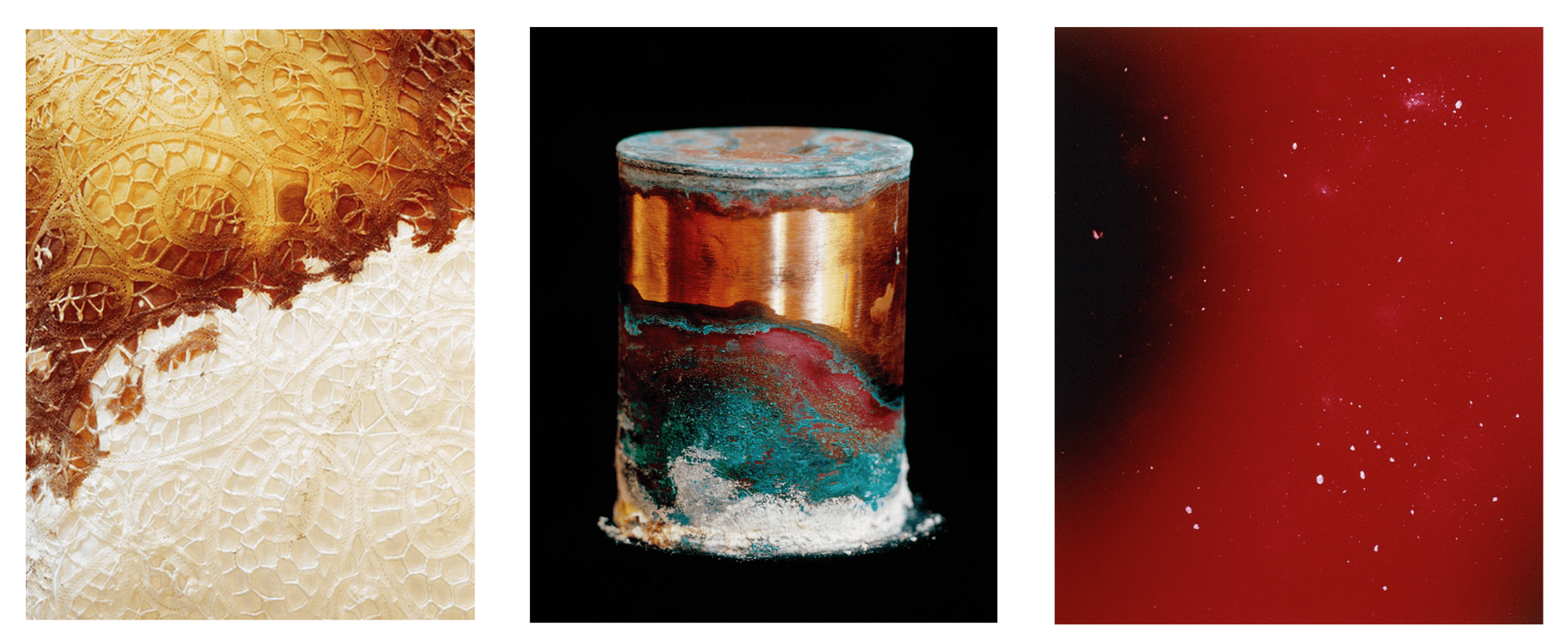
David Maisel’s Library of Dust photographs depict individual copper canisters, each containing the cremated remains of a patient who passed away at a state-run psychiatric hospital in Oregon and went unclaimed by family members. Water damage and temperature changes over time interact with the copper in ways that individualize each canister and raise questions about what happens to our bodies and how we might be remembered after we die.
Jason Lazarus
Chicago-based artist Jason Lazarus utilizes cremated remains of the late artist Robert Heinecken to create a series of unique color photograms. By sprinkling remains onto the photographic paper and employing a range of color combinations and exposures in the darkroom, the resulting prints are simultaneously an act of photographic chance and homage to the late artist who was a pioneer of experimental photographic processes.
Alexandra Pacheco Garcia
Alexandra Pacheco Garcia’s self portraits also utilize a photogram process—made by placing a piece of photographic paper over her face and exposing it to light. Outlines of a nose, lips, and chin emerge differently in each print, and formal relationships to death masks and graphite drawings are suggested as the artist attempts to performatively breathe life into the mortified photographic object.
Sarah Sudhoff
Large-scale color photographs from Sarah Sudhoff’s At the Hour of Our Death project reveal swatches of bedding, carpet, and upholstery, marked by bodies that have passed away on those surfaces. The artist works with a trauma scene crew to gain permission to document these imprints before they are destroyed, drawing attention to traces of death that are typically rushed out of sight.
Loren Schwerd and David Orr
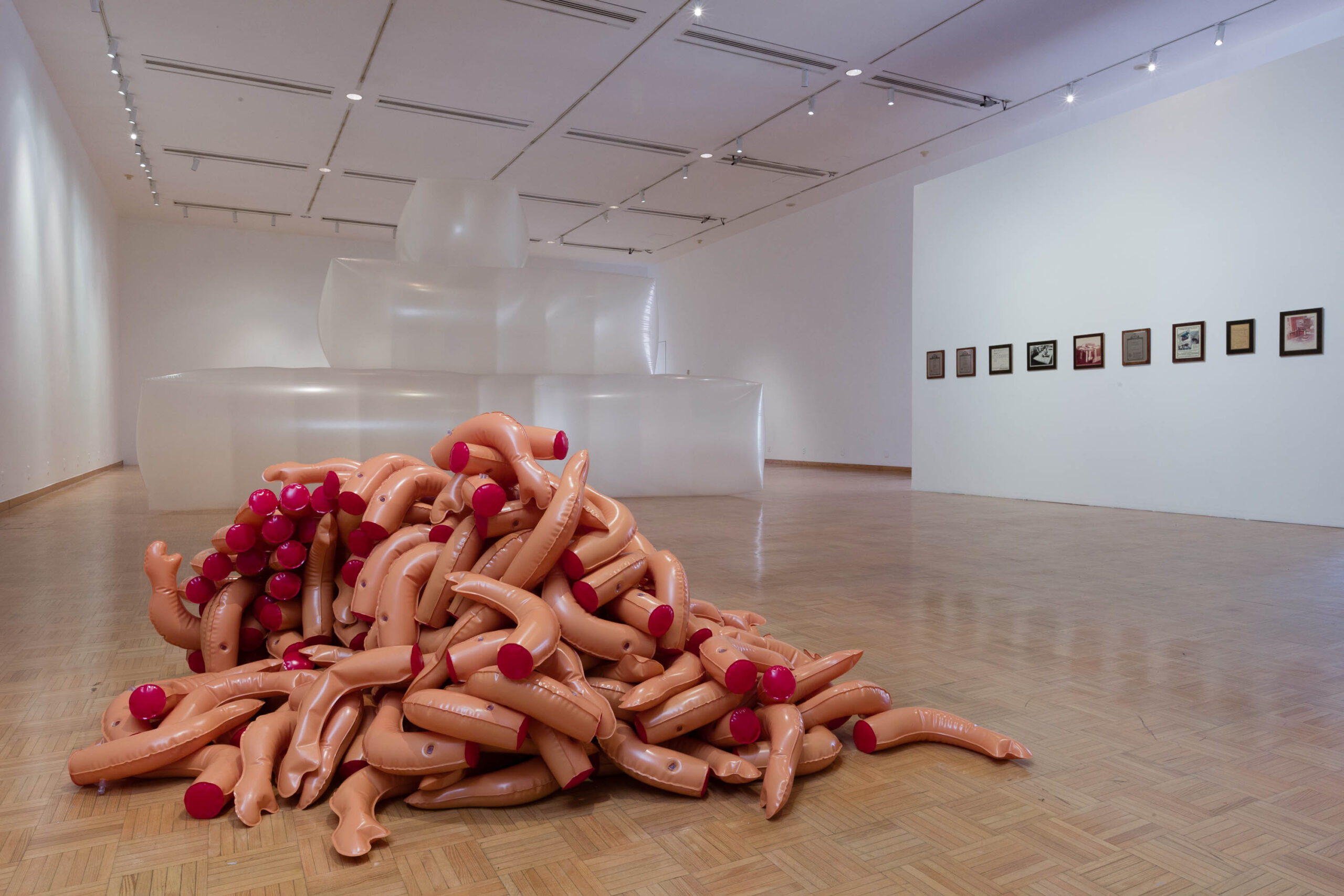
Loren Schwerd and David Orr ruminate on geographic sites of loss. Schwerd’s Mourning Portrait is a series of memorials to the communities of New Orleans that were devastated by Hurricane Katrina. Using human hair extensions that she found in her neighborhood after the hurricane, the artist weaves these into sculptural renderings of vacant houses in the Ninth Ward neighborhood. The works reference the 19th-century tradition of hairwork, in which family members and artisans would fashion the hair of the deceased into intricate jewelry and other objects as symbols of death and rebirth.
Andrea Bowers and Ira Sachs
Andrea Bowers and Ira Sachs present separate works that recognize the significant loss of lives due to AIDS-related causes. Sach’s 8-minute film Last Addressis an elegiac homage to a group of New York-based artists who died of AIDS between 1983 and 2007. It consists of footage of the exteriors of buildings—the last known physical addresses of these individuals. Bowers’ video Continual Maintenance and Mending documents Gert McMullin, a full-time seamstress who has cared for and mended the panels of the Names Project AIDS Memorial Quilt since its inception. Like other projects by Bowers, this piece demonstrates how women’s craft and political activism are often intertwined.
Kristine Thompsons
Kristine Thompson is an artist, educator, and independent curator. Her visual work addresses many of the ideas embodied in this exhibition, and has recently been exhibited at Commonwealth & Council, Los Angeles, and the Armory Center for the Arts, Pasadena. She worked for several years as a curator at UCR/California Museum of Photography, and she is currently Assistant Professor of Art at Louisiana State University.
- Past Events:
Opening Reception
The opening reception took place Saturday, March 29, 2014.