
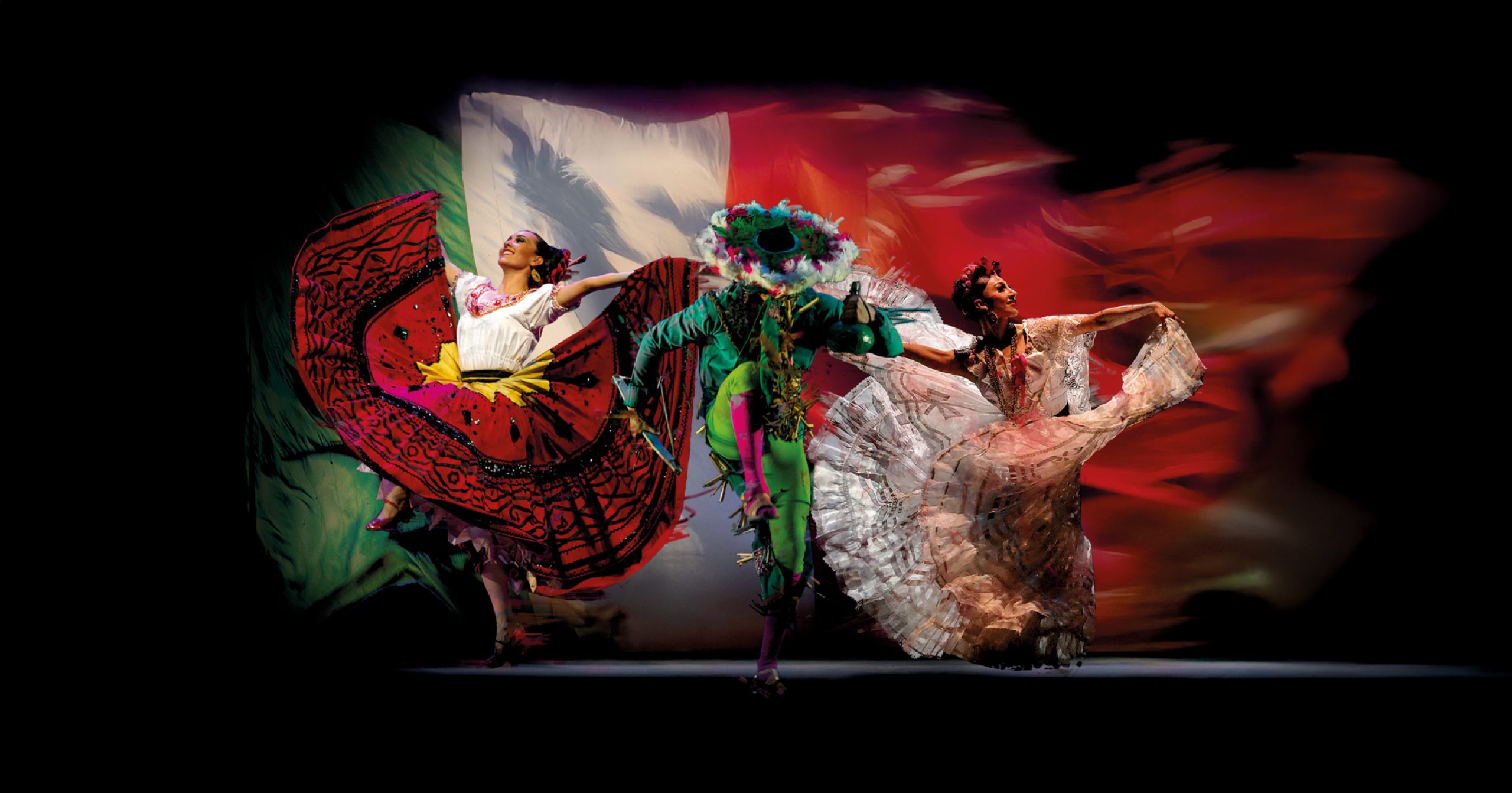


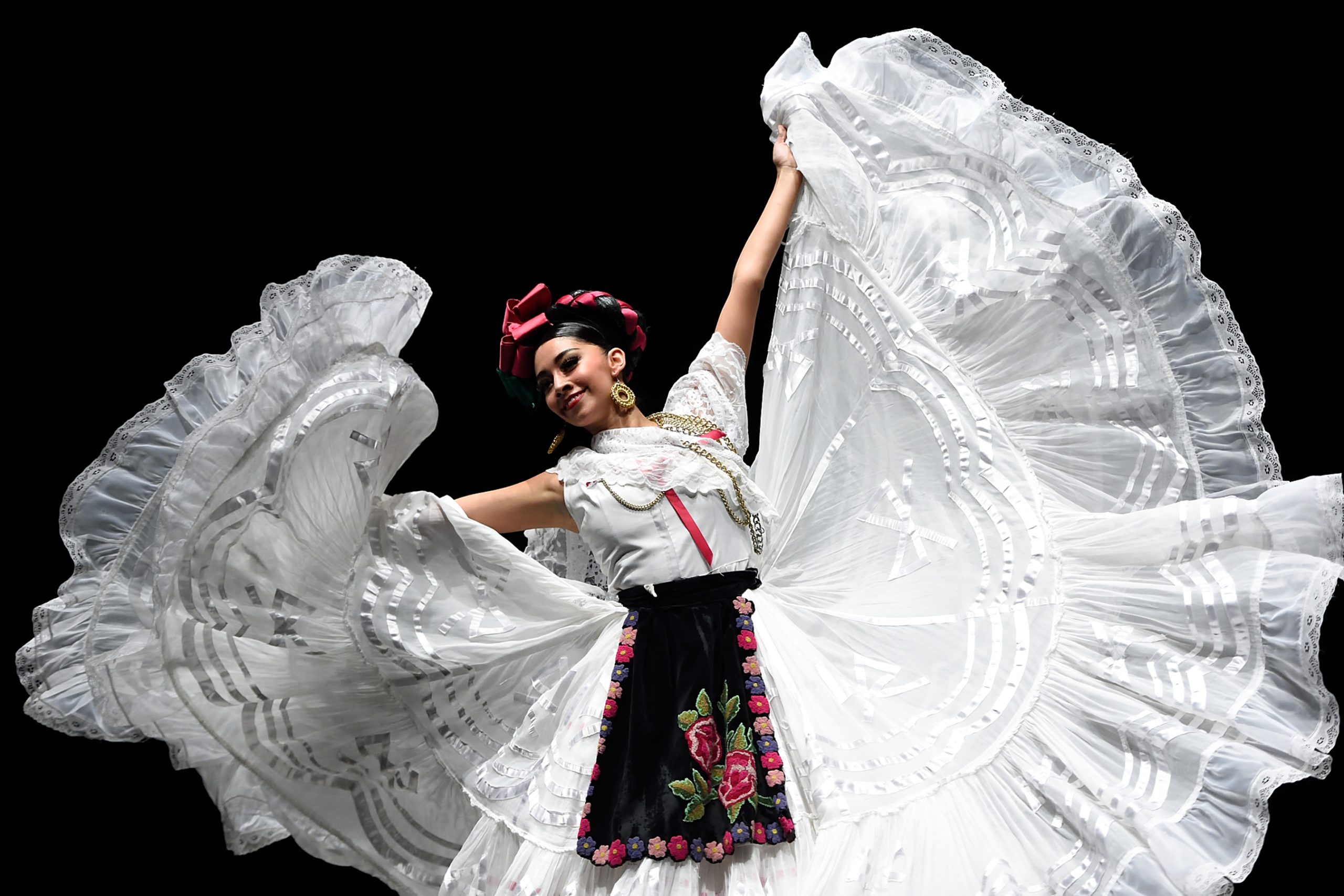
The world-renowned Ballet Folklórico de México de Amalia Hernández returns to The Luckman to celebrate its 75th anniversary with back-to-back performances on Saturday, February 6, at 8:00 p.m. and Sunday, February 7, at 2:00 p.m.
The Mexico City–based ensemble will present renewed versions of its most celebrated repertoire, preserving the rich culture and artistic traditions of Mexico through the dance, music, and costumes emblematic of Mexican folklore and history from pre-Columbian civilizations to the modern era. Since its founding, the company has created more than 40 ballets featuring exquisite choreography that pays homage to local dance traditions from more than 60 Mexican regions.
Amalia Hernández founded Ballet Folklórico de México in 1952 after embarking at an early age on a mission to preserve the dance traditions of her beloved country. Her goal was to share with Mexico and the world the beauty of Mexican dance from the pre-colonial era, the Hispanic Viceroyal period, and the popular traditions born during Mexico’s revolutionary years. More than seven decades later, the company is celebrated as one of the finest folkloric dance ensembles in the world.
The music, technical rigor, elaborate costuming, and Hernández’s choreography have helped the company and its followers share the richness of Mexican heritage with audiences around the world. Since 1959, the company has been permanently based at the magnificent Palacio de Bellas Artes in the heart of Mexico City and has performed on some of the world’s most prestigious stages.
About the Company
Over the past 75 years, Ballet Folklórico de México de Amalia Hernández has established itself as the most emblematic folkloric dance ensemble in Mexico and one of the most renowned worldwide.
Founded in 1952 by dancer and choreographer Amalia Hernández, Ballet Folklórico de México revolutionized the concept of traditional dance and reshaped the history of Mexican performing arts. The company set a new standard, influencing thousands of dance troupes in Mexico and beyond with the distinctive artistic vision of its founder. Amalia Hernández conducted in-depth research across various regions of Mexico, studying not only traditional dances but also their accompanying music, customs, and attire. She then reimagined these elements, infusing them with new meaning, restaging them, and sharing them with audiences through theatrical performances. With an avant-garde approach, she designed a groundbreaking production and established a cultural management model characterized by efficiency and professionalism on stage.
Amalia Hernández’s influence extended beyond choreography—she was also a visionary businesswoman and cultural promoter. Through her innovative productions, she redefined and elevated Mexican dance, bringing renewed appreciation to its rich heritage. Her dedication led to the formation of a company known for its discipline, perseverance, and extraordinary teamwork, making it the first professional folkloric dance ensemble in Mexico. Its impact on the country’s dance history was profound, introducing a model of cultural management previously unseen in Mexico.
Ballet Folklórico de México de Amalia Hernández has brought global recognition to Mexican culture and its artists, gaining immense prestige through creative excellence on par with the world’s greatest artistic achievements.
Today, its repertoire is considered a classic, yet it continues to evolve, transform, and flourish. With more than 45 million spectators and countless accolades, Amalia Hernández’s artistic legacy remains vibrant. Her more than 120 original choreographies, executed with remarkable technical precision, elaborate traditional costumes, and extraordinary dancers, solidify Ballet Folklórico de México as the premier company of its kind in the world.
About the General Director
Salvador López López is a businessman, promoter, charro, and sportsman whose participation in and commitment to his activities have always been outstanding. He joined Ballet Folklórico de México de Amalia Hernández in 1982, organizing tours in Europe, South America, the United States, Japan, Canada, the Dominican Republic, and other countries. These tours have amounted to more than six thousand performances for nearly twelve million spectators. For his outstanding contributions, Amalia Hernández appointed Salvador López as the legal representative and administrative director of the Ballet in 1986. From that moment on, he was responsible for operating the institution and establishing strategies and projects to ensure its future. Under his management, BFM has earned important awards, including the National Arts Award from the Mexican government, the Tiffany Award in New York, the Gold Medal of Fine Arts, the Lo Nuestro Excellence Award from the México Unidos Foundation, and the Auditorio Nacional’s Las Lunas Award, among others.
López performed with the Ballet for the first time during its 1987 Paris tour at Le Palais des Congrès. He was the main “floreador” during tours and performances at the Palacio de Bellas Artes. Due to the responsibilities of his current position, he only occasionally participates in this capacity.
In 1972, he joined the National Association of Charros as a member, winning two youth complete charro championships and leading several teams through his participation in sports. He was also part of the National Youth Team starting in 1974 and the Senior Team from 1976 onward. Additionally, he served on eight different Boards of Directors at the association. His sports career includes ten years of participation in charro competitions, during which he won several national co-leadership titles. He was president of the National Association of Charros from 2004 to 2006. In 1979, he competed in the National Athletics Championship. Since 1991, he has trained for triathlons and has participated in two IRONMAN competitions (4 km swim, 180 km bicycle, and 42 km run) in Germany and Canada. He was Triathlon National Sub-Champion in 1995, 1999, and 2001, and achieved third place nationally in 1998 and 2000.
About the Artistic Director
Born in Mexico City to teacher Amalia Hernández and Argentine writer Joaquín Basanta, Amalia Viviana Basanta Hernández began her dance studies at the age of five, training in traditional Mexican dance at the Ballet Folklórico de México and studying classical ballet under Nellie Happei. At 13, she joined the National Ballet of Mexico under Maestra Guillermina Bravo, where she trained in contemporary dance. She later pursued both modern and contemporary jazz techniques abroad, studying with esteemed instructors such as Alvin Nikolai, Murray Louis, Hania Holm, Alvin Ailey, and Horton Dunham.
In 1977, she returned to Ballet Folklórico de México as a dancer and was instrumental in reviving several out-of-repertoire ballets, helping to strengthen the future of the company founded by her mother.
By 1979, she was named Principal Dancer of Ballet Folklórico de México and later became its Artistic Coordinator—a position she has held for over 15 years—while also serving as director of BFM’s school for a decade.
Her research has been crucial in the creation of several of Maestra Amalia Hernández’s ballets, including Mexican Christmas, Sones y Gustos de Guerrero, and Tlaxcala, among others.
For several decades, Amalia Viviana Basanta Hernández has maintained an uninterrupted artistic and professional career as a dancer, with over 4,000 performances in Mexico’s most prestigious arts venue, the Palacio de Bellas Artes, as well as on international tours and in special guest appearances.
She has received numerous awards, including the César Chávez Medal from Michigan State University and the Artistry of Mexico Recognition awarded by the United States Congress. She was also honored with the Ulama Award for her work with the General Directorate of Industrial Technical Education of the Ministry of Public Education. Additionally, she was invited as a special guest soloist by L’Ensemble National de Folklore, Les Sortilèges in Montreal, Canada.
For more than 20 years, she has served as a distinguished jury member at the Meeting of Art and Culture of the D.G.E.T.I. In recognition of her contributions, she and Maestro Rodolfo Múzquiz Fuentes received the Sor Juana Medal. In 2010, the Mexican Association of Theater Critics honored her with a prestigious Recognition for her Artistic Career—marking the first time the organization awarded such a distinction in the field of dance.
In 2002, she founded the Amalia Hernández Dance Academy (ACADEZ) in Interlomas, Mexico, which has seen more than 300 students pass through its doors. Another of her enduring projects is Mexico in Motion Contemporary Dance Company, which she established in 2005.
Her choreographic work has reached beyond Mexico’s borders, with notable productions including: De Cara al Mar with the Grandeza Mexicana Dance Company; Fandango y Danzón with the Resurrección Company in Los Angeles; and Leyenda de la Mulata de Córdoba (contemporary dance) with the Cleo Parker Robinson Company in Denver, Colorado.
Amalia Viviana Basanta Hernández continues to inspire and shape the Ballet Folklórico de México through her artistic direction, the creation of new choreographies, and her commitment to teaching. Her works include Mexican Christmas, Easter, The Old Man’s Conga, Danzón No. 2 by Arturo Márquez (presented at Mexico City’s National Auditorium), Las Canasteras del Barrio de la Trinidad, Dance of the Feather by Amalia Hernández, and Pinotepa. She also actively contributes to and teaches at the Ballet Folklórico de México’s school, which her mother envisioned as a training center for folkloric dancers, dedicated to preserving and sharing Mexican culture through dance, both nationally and internationally.